
 How to Download Books
Mathematics, Police, Quiz
UP POLICE CONSTABLE MATHEMATICS WITH 25 TRICKS

09
Oct
Oct
UP POLICE CONSTABLE MATHEMATICS WITH 25 TRICKS
UP Police Constable Syllabus
UP Police Latest Updates

UP Police Constable Syllabus in Hindi (UP POLICE CONSTABLE MATHEMATICS WITH 25 TRICKS)
For your reference, here is the complete UP Police Constable Syllabus in Hindi in the below table. The candidates can begin preparing for UP Police Constable Recruitment with the topics mentioned below.
Subject |
Topics |
|---|---|
General Knowledge |
|
General Hindi |
|
Reasoning |
|
Numerical Ability |
|
Mental Ability Test |
|
Mental Aptitude Test |
|
Intelligence Quotient |
|
The Uttar Pradesh Police Recruitment and Promotion Board (UPPRPB) is soon going to conduct recruitment for the post of Police Constable. The official notification for the same is expected to release soon. Interested candidates can find detailed UP Police Constable syllabus in this article.
UP Police Constable Exam Pattern in English (UP POLICE CONSTABLE MATHEMATICS WITH 25 ट्रिक्स )
Here is the list of UP Police Constable exam pattern important points listed below:
-
The exam is Objective-based
-
UP Police (पुलिस) Constable exam consists of four different papers
-
General Knowledge
-
General Hindi
-
Numerical Ability
-
Mental Aptitude/IQ/Reasoning Ability
-
-
The overall weightage of the paper is 300 marks with 150 total number of questions.
-
Each question carries 2 marks.
-
There is a Negative marking 0.25 marks for every wrong answer.
Note: Candidates should be sure of their answers before attempting to avoid negative markings.
Candidates must practice UP Police previous year question papers to prepare well for the exam.
| Subjects | Total No of Questions | Marks |
|---|---|---|
| General Knowledge | 38 | 76 |
| General Hindi | 37 | 74 |
| Numerical Ability | 38 | 76 |
| Mental Aptitude/IQ/Reasoning Ability | 37 | 74 |
| TOTAL | 150 | 300 |

UP Police Constable Syllabus
The syllabus of the UP Police Constable Exam consists of four papers as mentioned previously. For brilliant preparedness for the examination, one must be thorough with the syllabus.
UP Police Constable Syllabus for General Awareness
This exam checks the general awareness of the candidates. In order to prepare thoroughly, one must do daily affairs every day and take up quizzes as much as possible.
Usually, current affairs of the past year or six months are generally asked in the exam.
-
History of India
-
Education, Culture, Traditions and Social Practices of Uttar Pradesh state
-
Indian Constitution
-
Indian Agriculture
-
India and its Neighbouring Countries
-
National/International Awards
-
Indian Culture
-
Indian Economy,
-
Population, Environment, and Urbanization
-
Indian and World Geography & Natural Resources
-
Human Rights
-
Revenue, police, and general administrative arrangements in Uttar Pradesh
-
Internal security and terrorism
-
Cybercrime
-
Demonetization and its impact
-
Goods and Services Tax
-
Social Media Communication
-
Important days
-
Countries / Capitals / Currencies
-
Discoveries & Research
-
Books and their authors, etc.
सबसे पहले इस किताब पर क्लिक करें
इसके बाद VIEW TEST PAPER पर क्लिक करें और इस हिंदी पुस्तक का निःशुल्क अध्ययन करें।
डाउनलोड करने के लिए, केवल 99 रुपये का भुगतान करें
UP Police Constable for General Hindi – हिंदी
This exam tests the candidates for their depth of knowledge and general command over the Hindi language.
-
हिन्दी और अन्य भारतीय भाषाएं
-
हिन्दी व्याकरण का मौलिक ज्ञान- हिन्दी वर्णमाला
-
मुहावरे एवं लोकोक्तियां
-
तद्भव-तत्सम
-
पर्यायवाची
-
विलोम
-
अनेकार्थक
-
समरूपी भिन्नार्थक शब्द
-
वाक्यांशों के स्थान पर एक शब्द
-
अशुद्ध वाक्यों को शुद्ध करना
-
लिंग
-
काल
-
क्रिया
-
वचन
-
कारक
-
सर्वनाम
-
विशेषण
-
वाच्य
-
अव्यय
-
उपसर्ग
-
प्रत्यय
-
समास
-
सन्धि
-
रस
-
छन्द
-
अलंकार
-
अपठित बोध
-
प्रसिद्ध कवि
-
लेखक एवं उनकी प्रसिद्ध रचनायें
-
हिन्दी भाषा में पुरस्कार, आदी
UP Police Syllabus for Numerical Ability
General mathematics questions are asked in the numerical ability section. The important topics are-
-
Number System
-
Average & Percentage
-
Decimals and Fraction
-
Ratio and Proportion
-
Profit and Loss
-
Discount
-
Simple & Compound Interest
-
Time and work
-
Use of Tables and Graphs
-
Time and Distance
-
Mensuration
-
Arithmetical computations
-
Miscellaneous
UP Police Constable Syllabus for Mental Ability
Check out the important topics for the mental ability section-
-
Logical Diagrams
-
Analogy
-
Word and alphabet
-
Letter and number series
-
Direction sense
-
Symbol- Relationship interpretation
-
Logical interpretation of data
-
The forcefulness of arguments
-
Common Sense Test
-
Perception Test
UP Police Constable Syllabus for Intelligence Quotient Test
Some important topics for Intelligence Quotient are –
-
Series Completion test
-
Coding-Decoding
-
Direction Sense Test
-
Relationship & Analogy Test
-
Spotting out dissimilar
-
Coding-Decoding
-
Blood Relations
-
Problems based on alphabets
-
Time Sequence Test
-
Venn Diagram
-
Arranging in order
-
Mathematical Ability Test
UP Police Syllabus for Mental Aptitude
The topics for Mental Aptitude are as below:
-
Public Interest
-
Law & Order
-
Crime Control
-
Rule of Law
-
Communal Harmony
-
Ability of Adaptability
-
Professional Information
-
Police System
-
Contemporary Police Issues
-
Gender Sensitivity
-
Interest Profession
-
Mental Toughness
-
Sensitivity towards minorities & underprivileged
UP Police Constable Syllabus for Reasoning Ability
The topics under UP Police Reasoning Ability are as below:
-
Similarities
-
Differences
-
Analogies
-
Space visualization
-
Visual memory
-
Observation
-
Discrimination
-
Analysis and Judgement
-
Problem-solving
-
Relationship
-
Verbal and figure classification,
-
Arithmetical reasoning
-
Arithmetical number series
-
Abilities to deal with abstract ideas and symbols and their relationship.
UP Police Constable Syllabus in Hindi
For your reference, here is the complete UP Police Constable Syllabus in Hindi in the below table. The candidates can begin preparing for UP Police Constable Recruitment with the topics mentioned below.
सर्वनाम

‘सर्वनाम‘ वे शब्द हैं, जो संज्ञाओं के स्थान पर प्रयोग किए जाते हैं।
जैसे-
श्याम एक अच्छा लड़का है। वह प्रतिदिन स्कूल जाता है।
इस वाक्य में श्याम के स्थान पर ‘वह‘ प्रयोग किया गया है। अतः ‘वह‘ सर्वनाम है। सर्वनाम का प्रयोग संज्ञा की बार-बार आवृत्ति को समाप्त करने के लिए किया जाता है।
सर्वनाम छह प्रकार के होते हैं-
1. पुरूषवाचक सर्वनाम
2. निश्चयवाचक सर्वनाम
3. अनिश्चयवाचक सर्वनाम
4. संबंधवाचक सर्वनाम
5. निजवाचक सर्वनाम
6. प्रश्नवाचक सर्वनाम
1. पुरूषवाचक सर्वनाम –
जो सर्वनाम बोलने वाले, सुनने वाले, अथवा किसी अन्य व्यक्ति (जिसके विषय में कुछ कहा जाए) का ज्ञान कराए, वे ‘पुरूषवाचक सर्वनाम‘ कहलाते हैं।
जैसे-
उसने मुझे बताया कि तुम कल आने वाली थीं। इस वाक्य में ‘उसने‘, ‘मुझे‘, और ‘तुम‘ पुरूषवाचक सर्वनाम शब्द हैं।
पुरूषवाचक सर्वनाम के तीन भेद हैं-
(क) उत्तम पुरूष
(ख) मध्यम पुरूष
(ग) अन्य पुरूष
(क) उत्तम पुरूष- जिस सर्वनाम को वक्ता अपने लिए प्रयोग करे, उसे ‘उत्तम पुरूष सर्वनाम कहते है। जैसे- मैं, हम, मेरा, हमारा, हमारी, आदि।
(ख) मध्यम पुरूष- वक्ता जिस सर्वनाम को श्रोता के लिए प्रयोग करे, उसे ‘अन्य पुरूष सर्वनाम‘ कहते हैं। जैसे- तुम, तू, तेरा, तुम्हारा, आप, (आदरसूचक) आदि।
(ग) अन्य पुरूष- वक्ता जिस सर्वनाम का अन्य व्यक्ति के लिए प्रयोग करे, उसे ‘अन्य पुरूष सर्वनाम‘ कहते हैं। जैसे- वह, वे, उसका, उनको आदि।
2. निश्चयवाचक सर्वनाम –
जो सर्वनाम शब्द पास या दूर की किसी निश्चित वस्तु या व्यक्ति का बोध कराते हैं, वे ‘निश्चयवाचक सर्वनाम‘ कहलाते हैं।
जैसे-
यह, वह , ये, वे आदि।
3. अनिश्चयवाचक सर्वनाम –
जो सर्वनाम शब्द किसी अनिश्चित वस्तु या व्यक्ति का बोध कराते हैं, वे ‘ अनिश्चयवाचक सर्वनाम‘ कहलाते हैं।
जैसे-
कोई, कुछ आदि।
उदाहरण –
बाहर कोई खड़ा है। दाल में कुछ पड़ा है।
4. संबंधवाचक सर्वनाम –
जो सर्वनाम शब्द एक सर्वनाम का दूसरे सर्वनाम से संबंध बताते हैं, वे ‘संबंधवाचक सर्वनाम कहलाते हैं।
जैसे-
जो-सो, जैसा-वैसा, जिन्होंने -वे आदि।
5. निजवाचक सर्वनाम –
जिन सर्वनाम शब्दों के प्रयोग से उत्तम पुरूष, मध्यम पुरूष अथवा अन्य पुरूष के अपनेपन का बोध होता है, वे ‘निजवाचक सर्वनाम ‘ कहलाते हैं।
जैसे-
आप, खुद, स्वयं, अपने, अपने आप आदि।
उदाहरण –
मैं स्वयं इसका पालन करूँगा।
6. प्रश्नवाचक सर्वनाम –
जिन सर्वनाम शब्दों का प्रयोग प्रश्न पूछने के लिए किया जाता है, वे ‘प्रश्नवाचक सर्वनाम कहलाते हैं।
जैसे –
कौन, क्या, किसे, किसने, आदि।
जैसे –
मेज़ पर क्या रखा हैं ?
बाहर कौन खड़ा है ?
Download Book [Click Here]
कारक (Case)
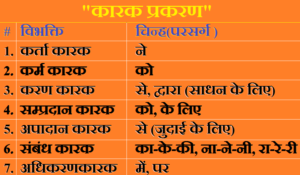
संज्ञा या सर्वनाम के जिस रूप से उसका संबंध वाक्य के अन्य शब्दों से जाना जाए, उसे ‘कारक‘ कहते हैं। कारकों का रूप प्रकट करने के लिए उनके साथ लगने वाले शब्द चिह्न ‘विभक्ति‘ कहलाते हैं।
कारक के भेद तथा उनकी विभक्तियाँ
कारक विभक्तियाँ
कर्ता ने
कर्म को
करण से,के द्वारा, के साथ
संप्रदान को, के लिए
अपादान से (अलग होना)
संबंध का,के,की,रा,री,रे
अधिकरण में,पर
संबोधन हे,अरे,रे
1. कर्ता कारक –
क्रिया को करने वाला ही ‘कर्ता‘ कहलाता है। इसका विभक्ति चिह्न ‘ने‘ है।
जैसे- मोहन ने पुस्तक पढ़ी।
मोहन (कर्ता) कारक हैं
कभी-कभी ‘ने‘ का प्रयोग नहीं होता,
जैसे- बच्चे गीत गाते हैं।
2. कर्म कारक –
शब्द के जिस रूप पर क्रिया का फल पड़ता है, उसे ‘कर्म कारक‘ कहते हैं। कर्म कारक की विभक्ति ‘को‘ है, जिसका प्रयोग प्रायः प्राणिवाचक संज्ञाओं के साथ ही किया जाता है।
जैसे- अध्यापक ने बच्चों को पढ़ाया।
‘बच्चों को‘ कर्म कारक है ।
कभी-कभी ‘को‘ विभक्ति के बिना भी कर्म कारक होता है,
जैसे- सुरेश ने पत्र लिखा।
‘पत्र‘ कर्म कारक है।
3. करण कारक –
कर्ता जिसकी सहायता से कार्य संपन्न करता है, वह पद ‘करण कारक‘ होता है। इसका विभक्ति चिह्न ‘से/के द्वारा‘ है।
जैसे- बच्चा चम्मच से खीर खाता है।
‘चम्मच से ‘ करण कारक है।

4. संप्रदान कारक –
जिसे कोई वस्तु प्रदान की जाए या जिसके लिए कोई क्रिया की जाए, उसे ‘संप्रदान कारक‘ कहते हैं। इसके विभक्ति चिह्न ‘को‘, ‘के लिए‘ हैं।
जैसे-
1. हमने गरीबों को वस्त्र दिए।
‘गरीबों को‘ संप्रदान कारक है।
2. मै अपने छोटे भाई के लिए खिलौना लाया।
‘छोटे भाई के लिए‘ संप्रदान कारक है।
5. अपादान कारक –
संज्ञा और सर्वनाम के जिस रूप से अलग होने का भाव प्रकट हो, उसे ‘अपादान कारक‘ कहते हैं। अपादान का विभक्ति चिह्न ‘से‘ है।
जैसे- वृक्ष से पत्ते गिरते हैं। ‘वृक्ष‘ से‘ अपादान कारक है।
इसके साथ ही ‘निकलने‘, ‘लजाने‘, ‘डरने‘, ‘तुलना‘, करने आदि भावों में भी अपादान कारक होता है;
जैसे- गंगा हिमालय से निकलती है।
चूहा बिल्ली से डरता है।
6. संबंध कारक –
शब्द के जिस रूप से किसी व्यक्ति या वस्तु का संबंध किसी दूसरे व्यक्ति या वस्तु के साथ जाना जाए, उसे ‘सबंध कारक‘ कहते हैं। इसके विभक्ति चिह्न ‘का‘, ‘के‘, ‘की‘, ‘रा‘, ‘रे‘, ‘री‘, हैं। जैसे-
वह मोहन का भाई है और वह मेरा मित्र है।
‘मोहन का‘ और ‘मेरा‘ संबंध कारक है।
7. अधिकरण कारक –
जिस संज्ञा या सर्वनाम पद से क्रिया के आधार का बोध होता है, उसे ‘अधिकरण कारक‘ कहते हैं। अधिकरण कारक के विभक्ति चिह्न ‘में‘, ‘पर‘ हैं।
जैसे- मछली पानी में रहती है और कौआ पेड़ पर बैठा है।
‘पानी में‘ तथा ‘पेड़ पर‘ अधिकरण कारक है।
8. संबोधन कारक – जब किसी संज्ञा को संबोधित किया जाता है, तब ‘संबोधन कारक‘ का प्रयोग होता है। इसके विभक्ति चिह्न ‘हे‘ ‘अरे‘ आदि हैं।
जैसे- हे लड़के ! इधर आओ।
‘हे लड़के‘ संबोधन कारक है।
YOU TUBE CHANNEL
https://www.youtube.com/channel/UCqgZUcwNLD-qinXvLAqZTog
REASONING
https://executivemakers.com/product/v82-reasoning-700-questions-full-solved/
उत्तर प्रदेश जनरल STUDY
https://executivemakers.com/product/v93-uttar-pradesh-gk/
We are Target No-1 Classes
A unit of
Executive Makers Pvt Ltd
Online and Offline batches start for all competitive and Academic courses…….
Download App…..Executive Makers
https://play.google.com/store/apps/details?id=co.thor.qccyq

Get Perfection With Executive Makers
[सामान्य अध्ययन] [GS]
ओलंपिक खेल (Olympic) सभी प्रतियोगी परीक्षाओं के लिए पूर्ण विवरण

हिंदी में
ओलंपिक खेल : प्राचीन ओलंपिक खेल पहली बार 776 ईसा पूर्व में ग्रीक भगवान, ज़ीउस के सम्मान में आयोजित किए गए थे।
आधुनिक ओलंपिक खेल 1896 में खेले गए थे। इन खेलों की शुरुआत पियरे डी कूपर्टिन ने की थी। ये खेल चार साल में एक बार खेले जाते हैं। अंतर्राष्ट्रीय ओलंपिक समिति (IOC) की स्थापना 1894 में चाखोन में हुई थी। इसका प्रधान कार्यालय लुसाने (स्विट्जरलैंड) में है। आईओसी में एक नेता, तीन उप नेता और सात अन्य सदस्य हैं। आईओसी के पहले प्रमुख ‘ग्रीस’ से ‘दिमित्रिया’ थे। आईओसी के प्रमुख के रूप में उनकी अवधि 1894 से 1896 थी।
‘भारतीय ओलंपिक परिषद’ की स्थापना 1924 में हुई थी और इसके पहले प्रमुख सर जे.जे.टाटा थे।
ओलंपिक प्रतीक : इसमें पांच छल्ले या मंडल शामिल हैं, जो सभी लोगों की खेल मित्रता का प्रतिनिधित्व करने के लिए एक साथ जुड़े हुए हैं। छल्ले महाद्वीपों का भी प्रतीक हैं – यूरोप, एशिया, अफ्रीका, ऑस्ट्रेलिया और अमेरिका। प्रत्येक वलय एक अलग रंग का होता है अर्थात नीला, पीला, काला, हरा और लाल।
ओलम्पिक ध्वज : ओलम्पिक ध्वज 1913 में ‘पियरे डी कौबर्टिन’ के सुझाव पर बनाया गया था। इसका उद्घाटन 1914 में पेरिस में हुआ था, लेकिन 1920 में एंटवर्प खेलों (बेल्जियम) में पहली बार इसे एक ओलंपिक स्टेडियम के ऊपर बनाया गया था।
ओलंपिक मशाल : 1928 में एम्स्टर्डम खेलों में पहली बार स्टेडियम के प्रवेश द्वार पर एक विशाल मशाल में एक ओलंपिक लौ जलाई गई थी। लौ का आधुनिक संस्करण 1936 में बर्लिन खेलों में अपनाया गया था।
ओलंपिक आदर्श वाक्य : ओलंपिक आदर्श वाक्य ‘सिटियस- अल्टियस- फोर्टियस’ (तेज़, उच्च, मजबूत) है। इस आदर्श वाक्य की रचना फादर डिडॉन ने 1897 में की थी। इस आदर्श वाक्य को पहली बार 1920 में एंटवर्प (बेल्जियम) में प्रस्तुत किया गया था।
ओलंपिक पुरस्कार और पदक : प्राचीन समय में ओलंपिक नायकों को जैतून की शाखाओं का ताज मिलता था और आधुनिक समय में ओलंपिक चैंपियन को पदक और प्रमाण पत्र से पुरस्कृत किया जाता है। विजेता एथलीट को अब स्वर्ण पदक मिलता है, दूसरे स्थान पर रहने वाले एथलीट को रजत पदक से सम्मानित किया जाता है और तीसरे स्थान पर रहने वाले एथलीट को कांस्य पदक मिलता है। इसके अलावा, पहली से छठी रैंकिंग वाले सभी एथलीटों को एक प्रमाण पत्र प्राप्त होता है।

कुछ मुख्य बिंदु
ओलंपिक खेलों में महिलाओं की भागीदारी 1900 में दूसरे ओलंपिक खेलों में शुरू हुई।
ओलंपिक खेलों में भाग लेने वाले पहले भारतीय खिलाड़ी एक एंग्लो इंडियन ‘नॉर्मन प्रिचार्ड’ थे जिन्होंने 1900 में दूसरे ओलंपिक खेलों में भाग लिया और एथलेटिक्स में दो रजत पदक जीते।
मैरी लीला रो ओलंपिक खेलों में पहली भारतीय महिला प्रतिभागी हैं।
आम तौर पर ओलंपिक खेलों के उद्घाटन समारोह में ग्रीस की टीम को पहला स्थान मिला और मार्च पास्ट परेड में मेजबान टीम को आखिरी में रखा गया। अन्य टीमों को अंग्रेजी वर्णमाला के वर्णानुक्रम में रखा गया है।
स्वर्ण पदक विजेता खेल महिला की अधिकतम संख्या लरीना लाव्यानिना है। उसने 9 स्वर्ण पदकों सहित 18 पदक जीते।
एक ओलंपिक में अधिकतम स्वर्ण पदक विजेता स्पोर्ट्स महिला क्रिस्टीना ओट्टी है। उन्होंने 1986 के सियोल ओलंपिक में तैराकी में 6 स्वर्ण पदक प्राप्त किए।
ओलंपिक में सर्वाधिक स्वर्ण पदक विजेता पुरुष खिलाड़ी यूएसए के माइकल फेल्प्स हैं। उन्होंने बीजिंग ओलंपिक 2008 में तैराकी में 8 स्वर्ण पदक जीते। उनका उपनाम ‘गोल्डन शार्क’ है।
ओलंपिक खेलों में शपथ लेने की परंपरा 1920 (एंटवर्प ओलंपिक) में शुरू हुई थी।
ओलंपिक खेलों में शुभंकर की परंपरा 1968 (मेक्सिको ओलंपिक) में शुरू हुई थी।
टेलीविजन पर ओलंपिक खेलों का सीधा प्रसारण 1960 (रोम ओलंपिक) में शुरू हुआ था।

In English
Olympic Games : Ancient Olympic games were first held in honour of the Greek God, Zeus in 776 BC.
The modern Olympic games were played in 1896.These games were started by Pierre de Coubertin. These games are played once in four years. International Olympic Committee (IOC) was established in 1894 at Chakhone. Its head office is in Lusane (Switzerland). There are one leader, three deputy leaders and seven other members in IOC. The first chief of IOC was ‘Dimitriyas’ from ‘Greece’. His duration as a chief of IOC was 1894 to 1896.
‘Indian Olympic Council’ was established in 1924 and its first chief was Sir J.J.Tata.
Olympic Symbol : It comprises five rings or circles, linked together to represent the sporting friendship of all people. The rings also symbolize the continents – Europe, Asia, Africa, Australia and America. Each ring is of a different colour i.e blue, yellow, black, green and red.
Olympic Flag : The Olympic flag was created in 1913 at the suggestion of ‘Pierre de Coubertin’. It was inaugurated in Paris in1914 but it was raised over an Olympic stadium for the first time at the Antwerp games (Belgium) in 1920.
Olympic Flame : It was at the Amsterdam Games in 1928 that for the first time an Olympic flame was lighted and burned in a giant torch at the entrance of the stadium. The modern version of the flame was adopted in 1936 at the Berlin games.
Olympic Motto : The Olympic motto is ‘Citius- Altius- Fortius’ (Faster, Higher, Stronger). This motto is composed by Father Didon in 1897.This motto was presented first time in 1920 in Antwerp (Belzium).
Olympic Prizes and Medals : While in ancient times the Olympic heroes received a crown of olive branches and in modern time, Olympic champions are rewarded with medals and certificates. The winning athlete now receives a Gold medal, the athlete in the second place is awarded a Silver medal and the third placed athlete wins a Bronze medal. In addition, all athletes ranking from first to sixth receive a certificate.
Some Main Points
-
Participation of women in the Olympic Games started in the Second Olympic Games in 1900.
-
First Indian player who participated in the Olympic games was an Anglo Indian ‘ Norman Prichard’ who took part in the Second Olympic Games in 1900 and won two Silver medals in Athletics.
-
Marrie Lila Ro is first Indian woman participant in the Olympic games.
-
Generally, in the inaugural ceremony of Olympic games the team of Greece got first place and host team is placed in the last in March past parade. The other teams are placed in the alphabetical order of English Alphabets.
-
The maximum number of gold medal winner sports woman is Larina Lavyanina. She won 18 medals including 9 gold medals.
-
The maximum Gold medal winner sports woman in an Olympic is Christina Otty. She got 6 Gold medals in swimming in Seoul Olympic of 1986.
-
The maximum Gold medal winner male player is an Olympic is Michael Phelps of USA. He won 8 Gold medals in swimming in the Beijing Olympics 2008. His nickname is ‘ Golden Shark’.
-
The tradition of taking oath in Olympic Games started in 1920 (Antwerp Olympic).
-
The tradition of mascot in Olympic Games started in 1968 (Mexico Olympic).
-
The live telecast of Olympic Games on television started in 1960 (Rome Olympic).


ONLINE COURSES :
AFCAT ENGLISH
https://qccyq.courses.store/97976?utm_source%3Dother%26utm_medium%3Dtutor-course-referral%26utm_campaign%3Dcourse-overview-webapp
ENGLISH GRAMMAR & WORD POWER
https://qccyq.courses.store/76719?utm_source%3Dother%26utm_medium%3Dtutor-course-referral%26utm_campaign%3Dcourse-overview-webapp
FOR MATHEMATICS
https://qccyq.courses.store/35906?utm_source%3Dother%26utm_medium%3Dtutor-course-referral%26utm_campaign%3Dcourse-overview-webapp
CAT
https://qccyq.courses.store/243640?utm_source%3Dother%26utm_medium%3Dtutor-course-referral%26utm_campaign%3Dcourse-overview-webapp
CTET PRIMARY & UPPER
https://qccyq.courses.store/133043?utm_source%3Dother%26utm_medium%3Dtutor-course-referral%26utm_campaign%3Dcourse-overview-webapp
SUPER TET
https://qccyq.courses.store/131047?utm_source%3Dother%26utm_medium%3Dtutor-course-referral%26utm_campaign%3Dcourse-overview-webapp
AIRFORCE Y
https://qccyq.courses.store/75060?utm_source%3Dother%26utm_medium%3Dtutor-course-referral%26utm_campaign%3Dcourse-overview-webapp
AND MANY MORE…..
Download App..
Download App…..Executive Makers
https://play.google.com/store/apps/details?id=co.thor.qccyq
LINKS FOR BOOKS :
ENGLISH GRAMMAR
https://executivemakers.com/product/complete-book-v188-english-grammar-for-all-competitive-exams/
SSC ENGLISH QUIZ
https://executivemakers.com/quiz-english-ssc-cgl-important-questions/
ENGLISH SPELLING TEST
https://executivemakers.com/product/tp-103-english-language-spelling-test-set-5/
ENGLISH FOR TET
https://executivemakers.com/product/v154-uptet-special-english-workbook-pdf-bilingual/
REASONING SERIES
https://executivemakers.com/product/tp-123-find-next-term-in-series-reasoning-set-5/
REASONING BOOK
https://executivemakers.com/product/v185-bilingual-reasoning-workbook/
REASONING SET PAPER
https://executivemakers.com/product/tp-37-reasoning-in-hindi-set-2/
TRICKY ARITHMETIC BOOK
https://executivemakers.com/product/tricky-maths-v187-bilingual-mathematics-book-for-all-competitive-exams/
ENGLISH WORD POWER
https://executivemakers.com/product/v172-english-word-power-idioms-one-words-phrases/
ENGLISH WORD POWER
https://executivemakers.com/product/v171-english-synonyms-antonyms-pdf/
QUIZZES:
RMS ENGLISH QUIZ
https://executivemakers.com/quiz-english-rimc-entrance-exam-2/
SAINIK SCHOOL QUIZ
https://executivemakers.com/quiz-english-sainik-school-entrance-exam-2/
RIMC ENGLISH QUIZ
https://executivemakers.com/quiz-english-rimc-entrance-exam/
AIRFORCE ENGLISH
https://executivemakers.com/airforce-x-y-english-quiz-03/
NDA ENGLISH
https://executivemakers.com/special-nda-english-champion-quiz-02/
AFCAT ENGLISH
https://executivemakers.com/afcat-airforce-english-quiz-01/
CAT (MBA)
https://executivemakers.com/quiz-cat-common-aptitude-test-for-mba/
BTECH APTITUDE TEST
https://executivemakers.com/free-quiz-b-tech-aptitude-quiz-01-english-mathematics-reasoning/
TET MATHEMATICS
https://executivemakers.com/quiz-tet-mathematics/
DELHI POLICE
https://executivemakers.com/%e0%a4%a6%e0%a4%bf%e0%a4%b2%e0%a5%8d%e0%a4%b2%e0%a5%80-%e0%a4%aa%e0%a5%81%e0%a4%b2%e0%a4%bf%e0%a4%b8-%e0%a4%b9%e0%a5%87%e0%a4%a1-%e0%a4%95%e0%a4%be%e0%a4%82%e0%a4%b8%e0%a5%8d%e0%a4%9f%e0%a5%87/
SAINIK SCHOOL MATHEMATICS
https://executivemakers.com/free-quiz-sainik-school-mathematics/
RMS MATHEMATICS
https://executivemakers.com/free-quiz-rms-mathematics/
SSC CGL MATHEMATICS
https://executivemakers.com/ssc-cgl-mathematics-quiz/
PET EXAM
https://executivemakers.com/upsssc-pet-quiz-all-subjects/
B TECH APTITUDE QUIZ
https://executivemakers.com/b-tech-aptitude-quiz-for-interview/
CTET QUIZ
https://executivemakers.com/free-quiz-ctet-primary-mathematics-questions/
UP POLICE BOOK
https://executivemakers.com/product/v131-up-police-book-pdf-in-hindi/
MATHS FOR UPTET, CTET AND SUPER TET
https://executivemakers.com/product/v170-maths-special-book-pdf/
GENERAL STUDIES ONE LINER
https://executivemakers.com/product/v169-general-studies-one-liner/
SCIENCE OBJECTIVE
https://executivemakers.com/product/v165-science/
ADVANCED MATHS
https://executivemakers.com/product/v164-the-advanced-mathematics/
ALZEBRA
https://executivemakers.com/product/v163-tricky-alzebra/
SCIENCE DESCRIPTIVE
https://executivemakers.com/product/v117-science-descriptive-pdf-in-english/
ENGLISH SET PAPERS
https://executivemakers.com/product/v99-english-set-papers-pdf/
GENERAL STUDIES SET PAPERS IN HINDI
https://executivemakers.com/product/v98-up-police-gk-set-papers-pdf-in-hindi/
BANK SET PAPERS
https://executivemakers.com/product/v97-sbi-bank-clerk-set-papers-pdf-in-hindi/
UP POLICE SET PAPERS
https://executivemakers.com/product/v96-up-police-set-papers-pdf-in-hindi/
